I’ll admit something that may surprise you.
When I first became a sonography educator, I wasn’t entirely sure where registry review fit into a student’s educational journey.
We spent years teaching anatomy, pathology, physics, scanning techniques, and clinical reasoning. We continually refined our curriculum, created new learning experiences, and worked hard to prepare students for both the registry and clinical practice.
So I found myself wondering: If students were already learning these concepts throughout their program, what made registry review so valuable?
Recently, while attending the IFSER Educator’s Summit, I discovered I wasn’t alone. During conversations with other educators, that same question came up more than once.
It’s an understandable one. As educators, we invest so much in our students that we naturally hope they’ll leave our programs feeling confident and prepared.
For a long time, I thought of registry review as simply another opportunity to revisit familiar material.
I’ve since changed my mind.
What Changed My Perspective
Early in my career, people would tell me how much a registry review course had helped them.
Honestly, I didn’t quite understand.
I never needed one as a student and I knew we’d covered the material.
Eventually, I attended one myself, just to see what all of this was about.
What surprised me wasn’t that I learned brand-new information.
It was that I heard familiar information presented differently.
Different examples.
Different analogies.
Different ways of connecting concepts.
And that experience completely changed how I viewed external reviews.
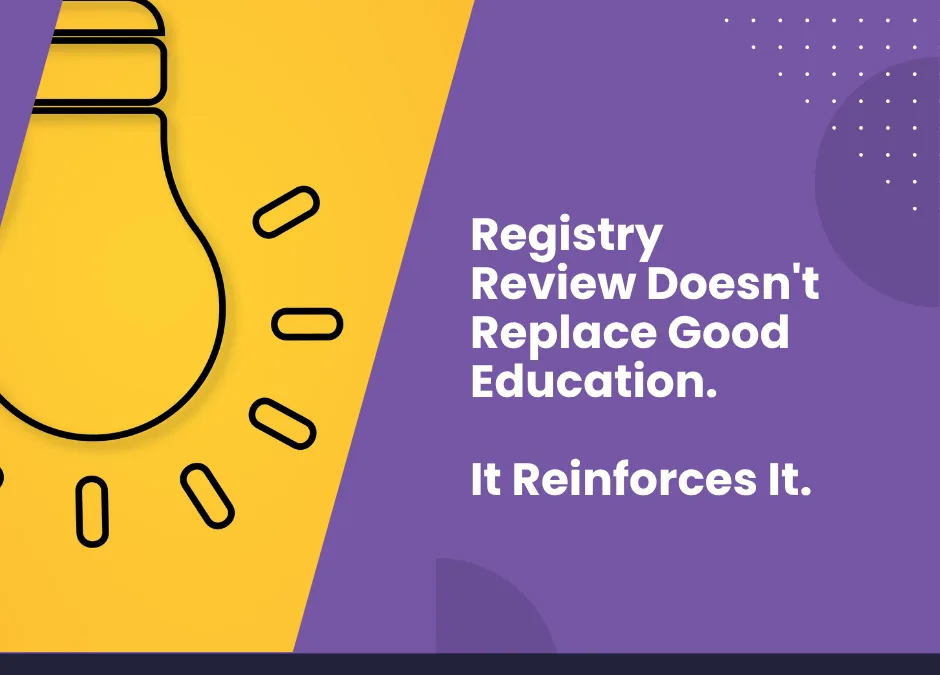
It wasn’t replacing education.
It was reinforcing it.
Students Don’t Need Different Content
Students don’t need entirely new information before taking the registry.
They need another opportunity to organize what they already know.
By the time students graduate, they’ve been exposed to an incredible amount of information.
Physics.
Instrumentation.
Anatomy.
Pathology.
Protocols.
Patient care.
Clinical decision-making.
That’s a tremendous cognitive load.
Registry review gives students an opportunity to step back and reconnect those ideas after months—or even years—of learning them individually.
Sometimes hearing the exact same concept from another instructor, using a different analogy or explanation, is all it takes for everything to click.
Different Voices Reach Different Learners
Every educator has strengths.
Some explain Doppler beautifully.
Others make pathology come alive.
Someone else has the perfect analogy for beam formation.
No single instructor will have the perfect explanation for every learner.
And that’s okay.
Students benefit from hearing concepts explained in different ways because every new explanation builds another pathway to understanding.
That’s not a reflection of ineffective teaching.
It’s simply how people learn.
Review Isn’t Remediation
One of the biggest shifts in my thinking has been recognizing that registry review isn’t about fixing a poor education.
It’s about strengthening a good one.
The same reason we encourage students to complete practice questions, participate in mock registries, attend conferences, read textbooks, and learn from clinical instructors is the reason registry review can be valuable.
Each experience reinforces previous learning.
Each provides another opportunity to connect the dots.
Each helps transform knowledge into understanding.
We All Have the Same Goal
Whether you’re a classroom instructor, a clinical educator, a registry review instructor, or a mentor in the scanning lab, we’re all working toward the same outcome.
We want confident sonographers who understand what they’re doing—not just for the registry, but for every patient they’ll care for throughout their careers.
No single class, textbook, instructor, or review course can accomplish that alone.
Education works best when students have opportunities to revisit important concepts, hear different perspectives, and continue building on the strong foundation their educators have already provided.
That’s not a sign that the original teaching wasn’t enough.
It’s a reflection of how meaningful learning happens.

Recent Comments